|
Tequila Production:
From Raw Agave to Epicurean Elixir
It takes at least eight years to make a bottle of tequila, sometimes as long as 20. That's because tequila is not made from the typical grains or fruits most alcoholic beverages are made from. It is distilled from the roasted centre (piña) of the blue agave (maguey) plant - the agave tequilana weber azul - one of 136 species of agave that grow in Mexico. It has a lifespan of 8-14 years, depending on soil, climate and cultivation methods, and will be harvested at between 8 and 10 years.
That's about 3,000 days before the harvest, a long time to wait.
 A farmer who plants a one-year-old shoot (hijuelo) today, in 2007, won't even harvest it for tequila until at least 2014, and maybe as late as 2018. And then, if it's aged at all it could take another one to five years before it appears on the shelf - 2015 to 2023. A farmer who plants a one-year-old shoot (hijuelo) today, in 2007, won't even harvest it for tequila until at least 2014, and maybe as late as 2018. And then, if it's aged at all it could take another one to five years before it appears on the shelf - 2015 to 2023.
An agave is a one-time use. It's not like a grape where you can plant a vine and have grapes every year. Imagine having to plan - and budget - for a product you won't see for perhaps another decade. Imagine having to care for and nurture those agaves from their planting to their harvesting, many years later, without knowing how the market will unfold in the interim, but still having to hire farm workers to weed, prune and maintain the fields.
The part of the plant that is used for tequila is the heart (root), or piña (also called the head, or cabeza), which looks like a large pineapple or pinecone. It starts underground, but soon pushes its way into the light. A mature piña usually weighs 80 to more than 300 pounds (36-136 kg, although most are harvested under 100 pounds/45 kg). Even 500-lb. piñas have been reported in the highlands, although they are rare.
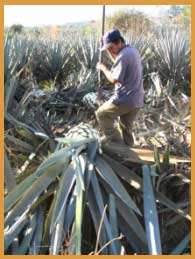
Tequila starts when the jimador - the harvester - cuts the agave from the ground and starts trimming away the 200-plus leaves that protect it.
Much of the work is done manually, rather than by machine, starting with the first planting of the agave shoots, through harvesting, right to the bottling of the final products.
While agave prices per kilogram are lower than sugar prices at present, the cost to harvest and process the agave to get the fermentable sugars is still higher than the cost of cane sugar, hence the continued prevalence of mixto tequilas.
It's about a seven-to-one relationship between the weight of the agave and the volume of the tequila produced. A single agave head, weighing 21 kg, will produce roughly 3 litres of tequila, after all the steps. At about 7 kgs per liter, a 45 kg agave will make 5 litres. Today most ripe agave heads average 50-60 kg, which will eventually make 7.1 to 8.5 liters of tequila.
Of course, it isn't that simple an equation: to get from raw agave to tequila there are many steps to take, each one essential to the final product, and a lot of water is needed to make that tequila, too. And it is in how each producer takes those steps and treats the process that the differences in tequilas is manifest. And the condition of the agave, its sugar volume, the type of yeasts and the use of chemical nutrients or accelerators also affect the yield.
|